Friday, March 27, 2009

British Summer Time

The clocks go forward tomorrow night, as we move from Greenwich Mean Time to British Summer Time, but is this really a sign of summer, warmer times with happier smiling people? I think not! The world is in crisis, not necessarily the crisis of war, but of changes to the human condition, the climate, the economy, all of which may already have tipped over the edge with few realising that this is indeed the case. Trauma and tragedy? Time will tell but when the fish of the sea are increasingly hermaphrodite, man's sperm count is less than half what it was fifty years ago, the seasons are more and more unpredictable with one polar cap soon to unfreeze each year, the world economy brought to its capitalist knees by the greed of bankers and money men, when will we see sense? 

No longer are we masters of our destiny! No longer do the winners write the history books; no, history is the province of a future we can only guess at, hardly predict. Out of our hands, man has committed the gravest of sins in recent decades, maybe longer. Industry has poisoned not only rivers and soils, but our minds as well. Our right to choice, that oft proclaimed plank of the right, but also now of the left, denies the trust for our world, a trust recognised by those we scoff at as animist or primitive, by those communities which are self-supporting and whose lifestyle does not threaten the future of the planet. And what of the "civilised" world with its consumption of resources far beyond nature's ability to produce? East mimics West and the impoverished South jumps on this bandwagon to a world desert.

But nature will always keep its own counsel and payback will be in its own time, not when humans decide. So what of our future? Our best hope may be to stop, to think, to reduce the demands we make on ourselves, family, neighbours, communities, governments and nations ...... and ...... and what? Live as vegetarians or vegans? Probably not! Become pacifist? No! Go Green? Maybe! No, the answer must be to work together, black and white, rich and poor, Christian and Muslim, believer and agnostic, woman and man, and review the minimalist lifestyle needed to bring nature and nations into harmony. So my hope for British Summer Time is that the Sun will shine, warm our hearts and minds, open our eyes and ears to the realities of this world, to aspiration not desperation, and that hand in hand, Afghan and American, Briton and Brazilian, Serbian and Sri Lankan will rebuild the future of mankind. 

After all, things can and do change; who would have guessed in 1991 that the next American president would be called Hussein?

Tuesday, December 04, 2007

Henry Ford was wrong

Henry Ford was wrong! History may not have much relevance for industry or commerce which he saw as being about production and profit, but history teaches us lessons which we ignore at our peril.

I have been beside the River Thames this week, just above the great lock at Teddington. This relentless flow of dark water only half-hiding the secrets it keeps, and half reminding us of the past! Old Father Thames it is sometimes called, and like the ancients respected for their wisdom, it has seen so much, forgotten more than we can ever know, there like an icon to cherish and respect.

As I ambled along the towpath with my grandson in the early winter sun, what did I see reflected in the still, slow waters? Bridges, clouds and overhanging trees, each with their meaning or is it interpretation, vision, fantasy or truth? Bridges, symbols of contrasting cultures; clouds and trees of changing times? Or later in the week with the increasingly fast waters of winter as the rains hit the counties around Berkshire, fleeting glimpses of these same shadows but impossible to identify as they were spoilt by wind and wave. Life is like that, sometimes slow and easy to read, at other times a rushing bedlam of incident and accident thrown relentlessly and unforgivingly into the chaos of life.

There are those who pretend to unravel these mysteries, finding patterns of repetition, fate and behaviour in their or our lives; others who finding no pattern to explain the tragedies of life, blame it all on God or man. And others still who see our successes and failures as the natural or inevitable outcome of the life-chances we each inherit. Marx would have some sympathy with this last option … little choice, just the oppressive and given domination of the masses by an elite. It matters not which group we are born to, the elite to rule in largely robust health, the masses to survive for a while at least the vagaries of poverty and oppression, ill-health, unsafe employment, idleness and frequent childbirth.

How did they survive, those who mastered the oppression of the market, slaves of a political creed that was largely British and white and mostly protestant? And where did Adam Smith figure in this history of ours? There are many who writing their observations of 19th or 20th century urbanisation, Marx or Dickens, Descartes or Churchill, who did little more than describe what they saw, their analysis failing to challenge the established mores of society, simply to set them in the stone of eternity, the way that the world was established for ever and a day!

Now Lenin and Mao may have been different for they challenged established but unequal order. They tore down the century old bastions of privilege and power, and in ways which terrorised commitment to the new order, allowing other pillars of the establishment such as Christianity and the Catholic Church to adopt the Marxist theory of social disorder to sanctify its dominance of government and people. The established church was everywhere, different in each country, but everywhere. The French even built the Basilica of Sacre Coeur in penitence for their failures in the Franco-Prussian war, a fine example of the integration of church and state in the common perspectives of an allegedly secular state.

Where have I strayed on this mentally, meandering journey which began with the purchase of a Ford Focus some weeks ago. Ford’s surname, passing into our automobile history, set me thinking about the relative degrees of freedom ….. that I enjoy? … that I appreciate? ….. that I value? ….. that I understand? ….. that are worth fighting for? ….. or whether nothing has changed in one hundred years? Still trapped in the sociological quagmire that is a conurbation of several millions of people, I may dream of liberty, of equality, fraternity, even sisterhood in these politically correct days, but nothing has changed; we are all trapped in the crowds between riches and poverty, in the dreams of improvement and the fears of losing the talents we have.

Christ was right! If we accept the coin of Caesar, we also pay homage to the ethos and edicts of the Czar. Henry Ford was wrong; it’s not history which is bunk but our literal and uncritical reading of the past.

Monday, October 23, 2006

Cry Hungary


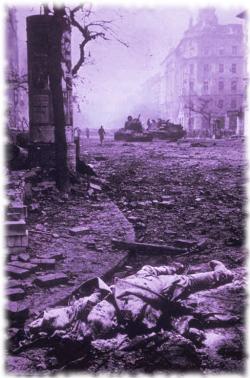
Fifty years ago tonight I lay in bed aged 13 listening to the reports of the uprising in Budapest. It is ironic that there is trouble in Budapest tonight! In 1956 the people were taking on the Russians; today there is division at home over the dishonesty of the government.

The Hungarian uprising was my political baptism. I knew nothing of politics, or democracy and oppression. I just listened all day and all night to the reports coming from Hungary of ordinary and often unarmed people facing up to the power of the soviets. This bravery was very impressive to me, a teenager. I wanted to be Hungarian, not British! I wanted to be there with the excitement and emotion of the fight. I knew nothing of the pain of living under the Soviet yoke, or the pain of death in this uprising. It was David and Goliath, and I wanted to be David.

The uprising (or was it a revolution?) changed my life, leaving me with a revulsion for "the Russians" as we called them, but not so strong that within a few years I saw capitalism as a greater threat. So today, after a lifetime of support for a political party and ideology which some might call socialism (not many I think) what is left? It is not for me to comment on Hungary and its people; their past is past, their future is theirs! But I have to say thank you ..... for my commitment to the poor against the rich, the weak against the strong, can be traced to the events in 1956 in the streets around Hősök Tere and Andrassy Avenue. so.... thank you for that. Without your struggle and the example of the Hungarian people, I would not be the person I am today.

Tuesday, October 10, 2006

Hero and Orator


Neil Kinnock, the man who rescued the Labour Party from impending oblivion, spoke at events in Manchester at the party Conference in late September. Great man, great orator, great photos!

Neil Kinnock was born eight months before and just a few miles from me. Always my hero both for his great oratory laced with Welsh fervour, and for the way he made Labour electable during the late 80s.

Friday, July 14, 2006

Lori Decter sings Mimi's Act I Aria from La boheme (Puccini)

My first attempt to add video to my blog. Let's hope the technology works.

As for a comment on La Boheme, just listen and enjoy!

Wednesday, July 05, 2006

Whose fence is this?


Sitting in my garden, I am surrounded by fencing two metres high but invisible to my eyes. It is covered from the ground upwards with ivy! Ivy? Yes that five-pointed leaf that repeats day after day, year on year and inch by inch, but never in the same shape or colour.

What do I see? Greens of every hue from dark and tough and ageing to small, new, fragile and light. And in between, every shade and misshapen size possible. There’s not a flower in sight, just millions of leaves each one covering the layers and leaves underneath, changing with the seasons and with the years but never changing the totality of cover over my lost and hidden fence.

If the fence was the ovum, the ivy was sperm! Millions of leaves which impregnated and in time turned into its own eco-system. Sustained by sun and rain, a shelter to frogs and birds, threatened by hedge-cutter and creosote, renewed by spring each year, but always home to a secret and silent community.

I closed my hand, pushed it between the leaves. More leaves? Yes, for a while, but they had lost their smoothness, and like the skin of an ancient naturist, were wrinkled, hard and crisp to the touch. They crumbled in my squeeze and fell to the ground. “Dust to dust,” says the good book?

Like motorways, railways, roads and paths, the ivy stems tangled and twisted to all points in this hedge. “Where I will,” they seemed to say. No architect, planner or bureaucracy here; just more and more growth and in amongst it, evidence of a huge range of creatures, spiders, ants, flies, beetles, centipedes, insects of every description, and all unwittingly approaching death by bird, hedgehog or other prey.

Where is the parliament to regulate this ivy? Where is the protest or the support? Where is the management and organisation? There is nothing I can find, save an eternal community, in balance but without committee. And underneath the ivy, long since lost to light, the fence lives on, save in its protective coat.

What lessons are there here for us? What can we learn from this peaceful idyll? Maybe to let nature take its course, to leave our world alone, to wrap ourselves in nature and not the reverse; but like each ivy leaf, we have no future and will not be missed. We make our input, just a little, we have our day, but in eternity, we barely figure, counting as even less than zero. A depressing thought? No, we are human, trustees of this universe, and destiny is ours, or is it mine alone?

(dedicated to Sylvie Garreau who gave me an empty book ..... in which to write!)

Thursday, April 20, 2006

The Thoughtful Sea!

I sat on age-old rocks in the warm of the sun and the cool of the wind at Calella de Palafrugell, wondering what these rocks would say if they were to give voice to their memories. Would they tell of a history of waves and weed, of fishermen and boats, of traditions which changed little over the centuries? Or would they speak with the forked tongues of men? Conscious of the differencees between Spaniard and Catalan, or facist and republican, or the modern invasion of tourists from accoss Europe. Is Calella Catalan any more? Is this the Costa Brava, or is it now Costa Turistica?

What has Calella lost since the BBC proclaimed it to be the least spoilt destination in Spain? To sit on those rocks in winter or spring; to dream with the gulls, to ferret around with the sparrows, to look into a swirling cremat, to sip on cafe solo, to enjoy the saltiness of Vichy water, solsos at lunchtime, the rocky crust of crema catalana, simply to be alone with history, culture, language, music and oneself .... these are forever lost. Tourists bring money and with money change ... eternal revolution of homes and bars, of tracks which become roads, and roads which grow into motorways.

So I sat and thought of these rocks and the stories they cannot tell ... how the sounds of the sea reassures those who doubt the realities of our world, how cormorants return each year to this remote pasture, how multitudes of fish are able to hide beneath these clear waters. The world goes on, mi amigo. It does not deny the superficial nor the beneficial, but human activity is on the edge, one facet only and the spirit of the earth and sea lives on. Garcia Marquez is right, the spirits walk our world, unseen by most, and only the spirits understand the force, the power, the omnipotence of nature. Our world is safe, if only we knew it!

Monday, April 17, 2006

April in Madrid!

Oh, to be in England
Now that April's there,
And whoever wakes in England
Sees, some morning, unaware,
That the lowest boughs and the brushwood sheaf
Round the elm-tree bole are in tiny leaf,
While the chaffinch sings on the orchard bough
In England—now!
And after April, when May follows,
And the whitethroat builds, and all the swallows!
Hark, where my blossomed pear-tree in the hedge
Leans to the field and scatters on the clover
Blossoms and dewdrops—at the bent spray's edge—
That's the wise thrush; he sings each song twice over,
Lest you should think he never could recapture
The first fine careless rapture!
And though the fields look rough with hoary dew,
All will be gay when noontide wakes anew
The buttercups, the little children's dower—
Far brighter than this gaudy melon-flower!

A poem by Robert Browning ..... but .... 12 April 2006 .....


Oh to be in England now that April´s here!
On this occasion, no contest .... the Copa del Rei with son-in-law Mario, and Español´s somewhat unexpected 4 - 1 victory over Zaragoza was an event to savour... a moment of history, a moment to enjoy being out of England!

Forza Español! Posted by Picasa

Friday, March 31, 2006

The Flea

A poem by John Donne that I have not read in many years ... but its meaning improves with age!

MARK but this flea, and mark in this,
How little that which thou deniest me is;
It suck'd me first, and now sucks thee,
And in this flea our two bloods mingled be.
Thou know'st that this cannot be said
A sin, nor shame, nor loss of maidenhead;
Yet this enjoys before it woo,
And pamper'd swells with one blood made of two;
And this, alas ! is more than we would do.

O stay, three lives in one flea spare,
Where we almost, yea, more than married are.
This flea is you and I, and this
Our marriage bed, and marriage temple is.
Though parents grudge, and you, we're met,
And cloister'd in these living walls of jet.
Though use make you apt to kill me,
Let not to that self-murder added be,
And sacrilege, three sins in killing three.

Cruel and sudden, hast thou since
Purpled thy nail in blood of innocence?
Wherein could this flea guilty be,
Except in that drop which it suck'd from thee?
Yet thou triumph'st, and say'st that thou
Find'st not thyself nor me the weaker now.
'Tis true ; then learn how false fears be;
Just so much honour, when thou yield'st to me,
Will waste, as this flea's death took life from thee.

Wednesday, March 08, 2006

And Death Shall Have No Dominion

And death shall have no dominion. 
Dead men naked they shall be one 
With the man in the wind and the west moon; 
When their bones are picked clean and the clean bones gone, 
They shall have stars at elbow and foot; 
Though they go mad they shall be sane, 
Though they sink through the sea they shall rise again; 
Though lovers be lost love shall not; 
And death shall have no dominion. 
 And death shall have no dominion. 
Under the windings of the sea 
They lying long shall not die windily; 
Twisting on racks when sinews give way, 
Strapped to a wheel, yet they shall not break; 
Faith in their hands shall snap in two, 
And the unicorn evils run them through; 
Split all ends up they shan't crack; 
And death shall have no dominion. 
 And death shall have no dominion. 
No more may gulls cry at their ears 
Or waves break loud on the seashores; 
Where blew a flower may a flower no more 
Lift its head to the blows of the rain; 
Though they be mad and dead as nails, 
Heads of the characters hammer through daisies; 
Break in the sun till the sun breaks down, And death shall have no dominion. 

Dylan Thomas

Wednesday, March 01, 2006

Letter to Peter

Dear Peter

I was at your funeral this morning, trying to make sense of it all, all that pain and hurt and sadness …. asking myself the question … “why?” And yet through the tears, I also asked, “why not?” After all we have no monopoly over life and death; why should it be early or late in life, and why should we always be able to predict the timing of this inevitable event?

I looked at faces racked by tears, red-stained eyes that looked worn and old, noses than ran sore and were wiped incessantly. I felt the collective heave of a community bound together in the grief of your death. Family, friends from school and from life, colleagues from work, and those who were there only because they knew your name and who you were, all caught up in what we hoped would be a celebration of your life, but inevitably became for many, a catharsis, and for some a trauma.

Phil talked about your illness, Ged about your life and work, but so many spoke only to themselves and to their God, knowing there was no answer to the questions “Why?” and “Why not?” We listened to these brave words from those who would do anything to go back a week, pick up a telephone, call at the house, do something different to change the course of history, and thus not need to be here today. All pointless … we cannot go back. We make our choices and must live by their reward.

Phil started and ended with the reminder that no event, no one illness can define or determine you or anybody else in our world. We are who we are with all our history, successes and failings, laughter and tears, choices made and avoided, friends and colleagues; we are all these things and not just the final event of our life.

It was good to hear this, reassuring, and it reminded us of all the pleasure that you gave us at home, at school, at work. Your work is not undone by death; it is perpetuated, complete. Your laughter, your energy and commitment is not lost; we are the people that you influenced, that you helped to form; and so your qualities and something of you, live on in us.

So, Peter, look down on us from wherever you are, smile your smile and talk your talk. Maybe when we look at sun or moon, your face will be there. When we hear the sound of that gentle wind it will carry your muffled words into our world. Whatever else you do, remember that we loved you, the person you were and the person you remain, and then, my friend, my child ….. rest in peace.

Friday, February 24, 2006

Gethsemane

is being alone with your thoughts, sharing them only with your God!

Thursday, February 09, 2006

Dawn or realisation?

I boarded that train at some provincial stop, and at some unearthly hour. This is my job, I told myself and sank into seat. As night gave way to dawn, to light, to landscapes, to skies, what did I see? People? No, this land is empty of them, but full of fields and folds, copses and ponds, lanes and tracks which all deserted looks so natural. Only the canals and bridges look man-made. Man’s influence seems almost sympathetic as hamlets, farmhouses, barns and stacks pass by. What I cannot see is the track on which we ride, this iron road rebuilt on white and soon to be grey stone, fenced in with railings which in time will rust. And as they do, will they blend in and be consumed by this rural scene? 

Will earth’s colours again assume their dominance? Can cuttings and embankments, straight and fine, ever stand out against nature, or will they mellow, soften, and be weathered by wind and rain and sun? This arrow, this sharp and silver shape, cuts through our land at speeds we cannot comprehend. London in two hours they say, when once it took a week! But trains are urban, not rural, filled with the urges and noises of those who work and chatter and shout orders down their phones. Why can they not stop for a moment and take in what they do not see. Obsessed by work, efficiency and outcomes, they take their worries and concerns, their intensity and commitment, to transform this world they say … for the better, and without even a glance at these passing sights, this ancient world which will see us out. A world of quiet, of birds, of rats and shrews we never see, of quiet cattle, of sheep, of those who mind their own affairs, those who relax, take the longer view, and take life as it comes. So town and city dwellers just halt your race into oblivion. 

The train speeds not to London, but to eternity. One gets on, but will it ever stop? Like some great wheel, the train speeds on, in relentless chasing of a perfect world. Think on, my friend; this is not heaven but hell, a denial of our humanity, a false faith in our dominion when what we need is quiet and humble eyes for the marvels we have missed. Sleep on my friend, and when you wake, the world will not have changed.

Wednesday, February 08, 2006

Os pensamentos num trem

I woke to the sound of overwhelming, utter exhaustion. The mobile was ringing, waking me from a sleep induced by the monotony of the rhythm of the train. All day I had discussed, debated, analysed, and to what purpose? Putting the world to rights, condemning injustice, Opposing anarchy? No, none of these; just reflecting on the differences between the meanings of monitoring, evaluation and review! If only we spent our time productively. We protest out commitment to efficient service delivery, and what do we do? Use our tongues rather than our hands, our mouths rather than our heads! Is this like the difference between Lenin, Stalin and Trotsky? Who proved to be the most effective? Was it the thinker and planner, or the one who acted decisively? One left us a political philosophy, another a corrupt and inhuman empire; the third was exterminated because of the threat he posed. 

The parallel for today might be the interactions between militant Islam and the secular West. The former protests at the cartoon sacrilege upon their prophet (peace be upon him), oppressed both by Western domination of oil and the vestiges of a thousand years of clerical rule. Meanwhile, in the name of freedom, our governments and peoples rape the resources of our world, threaten the future of the planet and of humanity, jeopardise the quality of the very air we breathe, and are never brought to account for these crimes. 

Our world is in our trust, not our ownership or dominion! Meanwhile, in Latin America, in Africa, in Asia, and in so many of the West’s urban centres, people suffer and starve in the names of capitalism, secularism and religion. When did religion last protest on behalf of the poor? Nearly always it is tied into a political regime. While our prophets prophecy in truth and in justice, Christians at least have both oppressed and been oppressed in the name of Jesus. Of other prophets, I cannot speak. Maybe I should take refuge in sleep, undisturbed by worry, concern, pain and violence, or the threat of these. Back to sleep on my train. Boa noite meu amigo!

Wednesday, October 12, 2005

A Village of two faces?

I drove through Lymm this afternoon, a posh yet unpretentious place, the product of centuries of growth and decline. So close to Mother Nature, yet so lacking in life. Maybe it was the mist and rain, the damp and cold, the wind and rain, the wet and cold that drove the living into their tomb-like homes. Closed doors, locked doors, curtains drawn to hide from the outside world, like cowards wrapped in comfort, escapees trapped in another jail. What of the life of those who haunt the fields on this drab, drab day. Excluded from these cells, they walk alone, but in the company of trees, of hedges, of fences which have weathered these extremes. They may be wet but they are warm with the lashing gale on hooded heads, in tune with season, time and age. 

The steeple pierces the low-blown clouds, wrapping this Cheshire world in fast-moving grey. The Lymm Damn, that still flat lake protected by its slopes and woods, its surface broken only by the blown leaves and by those still small ducklings rippling like a chain as they race for cover. Dark, black, murky, even haunting is the feel of that spot. As night approaches, there is no good here. Away! And so as Autumn grows, I ask, “Quiet, empty, still, where are they all, the people of this place, hiding in the remoteness of their homes?” Their trimmed hedges, lawns and borders betray a people chained to garden habits, like robots, automatons in a marble world. 

And where is nature? Hiding round the corner? In that field, waiting its chance to return and once again go soft and green? Patient, untidy yet at peace!

Tuesday, September 06, 2005

No Man is an Island

"All mankind is of one author, and is one volume; when one man dies, one chapter is not torn out of the book, but translated into a better language; and every chapter must be so translated...As therefore the bell that rings to a sermon, calls not upon the preacher only, but upon the congregation to come: so this bell calls us all: but how much more me, who am brought so near the door by this sickness....No man is an island, entire of itself...any man's death diminishes me, because I am involved in mankind; and therefore never send to know for whom the bell tolls; it tolls for thee."

John Donne (1572 - 1631)

Monday, September 05, 2005

America, America

I have been just once to the USA, the north-eastern corner, but we call the huge country America which it is not! So much confusion about the difference between perspective and reality. And of the last week since Hurricane Katrina ……? Who am I to comment on the USA, Bush, the people of New Orleans, the black poor, the politics of America, the media? Just an interested and committed observer, appalled by the images of the last few days, of old people dying on camera, of babies dying of thirst, of patient and composed people waiting patiently for their fate, of parents risking their lives for their children, of others giving their lives to the rescue. 

And what do our TV screens show? White policemen targeting looters while their poor and black brothers and sisters starve. It seems to me that irony is not strength of the local media and politicians. What victory is there in parading a looted television in a city without power? What arrogance to knock stolen food from the hands of a father anxious to feed his family. When the world stops, people have time to reflect, and reflections can be brutal. The Image is of overwhelmingly black people trapped in this flood … those who could not escape. “Give me your poor” says the Statue of Liberty but the American dream does not liberate; it entraps so many in poverty and repression. 

The President, were it not so shameful, is a figure of fun and derision at home and abroad. He is naked, with no judgement, poor communication skills, and no instinct for intervention. However, he has a vision of a rebuilt New Orleans at a time when people are drowning in a sea of faeces and corpses. Most of all for a conviction Christian, he does not look for meaning and understanding in this sign from his God. The Media change their take on the story from day-to-day. First there was the hurricane, then death and damage, then the human stories, followed by political indifference, but thank God, the looters saved the day and allowed us to report “increasing lawlessness and violence”, something that would put the blame for this mess firmly in the poor black communities. Finally, after days of criticism, came the Marines and Fox News reporting so eloquently on the effectiveness and commitment of these cavalry from over the horizon (bring back Reagan and the cowboy films of old)! How easy it is to turn tragedy into success! 

The British in our inimitable style have done little except watch and listen. Our greatest ally is in big trouble and there is no national mourning, no great appeal for help. We have not even been encouraged to send donations. What does this tell me? That while the suffering people are to be pitied, their government and country are not. That there is a belief that if the USA is so great, it deserves the opportunity to resolve this situation without outside help. Not our problem, we seem to be saying. As a nation, we may be embarrassed at our own silence, but at least we are asking the question of ourselves about the meaning and relevance of our life. The End Game! 

The world will never be the same again. The USA is enfeebled by this tragedy more than by Vietnam and 9/11. Its economy is threatened. The world’s greatest military power has little heart, little compassion for its own, never mind the rest of the world. Is this the death of capitalism? Never. As always, it will present the rise in oil prices, the impoverishment of millions by the catastrophe as an opportunity for individuals to make an impact, to succeed, and to break out of their imprisonment in poverty … the American Dream! Ha! As for “little government”, the flagstone of Republican politics for a generation, where were you when you were needed? With your rich friends, safe from the winds of change. Big government might have been slow to react, but at least it speaks for all the people. If liberation is action on behalf of justice, then this blog is nothing, as are the words of all those who pontificate on Katrina and its consequences. Prayer and sentiment may help us as individuals. Who will help the poor of New Orleans?

Tuesday, August 23, 2005

On Twenty Wasted Years!

A Brazilian friend has just asked the question, “Are you a man or a mouse?” In the context of my first world credentials, it is a hurtful question, and it needs to be. Whatever happened to my commitment to the third world, to my study of Liberation Theology in the 1980s? Liberation can never be study; it is always action, in this case, action by the poor in light of the gospels. So where did I go wrong? History, politics and salvation are in the soul of most people, where we came from, what we hope for, and our current ambition and commitment. The West has no ambition, simply platitudes, conservatism and a wish to retain the present state at all costs. 

So what of my history, my politics and my salvation? My family originated in poor agricultural and then mining stock; I was one of the first in my family to go to university. Did I turn my back on their poverty? … on their history of oppression in Ireland and in the Welsh mines? Do I still value their principles and what they worked and stood for, or am I just another catholic capitalist paying lip-service to justice and peace? The enslavement of generations of Latin Americans in sinful structures supported by the Church and state challenges not the existence of God, but the identity of God. It is clear from Old and New Testaments that to know God is to do justice; the Church (both the institution and individuals) is failing the people. Scripture cannot support a political ideology of oppression and exploitation which is anti-Christian. The gospels renounce any identification with rich and authoritarian societies and their compromise with capitalism and imperialism. Didn’t Christ reject the coin and the head of Caesar … if we accept the coin, we accept all that goes with it … this is prophecy! 

The witness of the Church is the process of liberation, liberation from sin and oppression. Structural factors, economic rationalism and development theory perpetuate the same neo-colonialist existence that they pretend to challenge. They deny Latin America the opportunity to value its Indian and Iberian cultures and traditions, and to integrate its hopes into regional solutions. It is time to renew the relationship between political activity and Christian faith. When will the Church give witness to community rather than to communities? A clinic in a Peruvian village is no response to oppressive employment practices and the need for agrarian reform. It is a sop to the conscience of the West. Transformation of society is required with Christians opting for political action rather than personal prayer! 

From Puebla onwards, the tension between these two views has been marked. We have a choice, a “popular church” united in a struggle for liberation, or a “magisterium” trapped in its own theological bureaucracy, a choice between an egalitarian distribution of wealth and the need for cheap labour, a choice between participation and shared decision-making and the doctrine of national security. God’s people are, like Christ, free, redeemed, but we need to be evangelised in the gospel of Christ, not that of Mammon. 

Christ gave us humans freedom in our relationship with the world (we are trustees), freedom in our relationships with each other, and freedom in our relationship with God. Our world is typified by the sinfulness of ambition and envy, and these produce injustice, domination, violence and conflict at all levels of society. It is significant that the false evangelisation of centuries has made a virtue out of poverty, but theology is written by the rich and powerful. Is it “blessed are the poor” or “blessed are the poor in spirit”? True evangelization will enable us, not to ape the sins of our oppressors, but to proclaim the gospel of liberation. It is ideology and idolatry to associate God with domination and exploitation. The Church has failed! It is time for me to choose. Am I a man or a mouse?

A Reflection on Helplessness !

Physical and intellectual overwork brought me to my knees. Exhaustion was utter, total and overwhelming. I was unable even to climb the stairs to bed that Sunday evening. The therapy of physical endeavours, as a contrast to the mental stresses of the week helped only to allow my body and mind to protest, and as I crawled crab-like to the bathroom at dawn, I knew that my brain had taken over from my heart. My world was spinning in a clockwise ellipse, relentlessly pursuing its course around me. Closing my eyes could not shut it out. Retching like a child could not change it; nor could the almighty sweat which drenched me and the floor on which I sat. What was I to do? Nothing …. For probably the second time in my life I was helpless, unable to help myself, only this time I knew it; I understood! 

Labrynthitis is not pleasant. Its disorientation is total. It does not respond to drugs, only to time, and of that I have plenty. Those two skulls, one inside the other which moved at different speeds, one always following the other, make for discomforting life. To lie still is one’s only hope, but patience is a virtue which is not my strength. So to reflect on life and love and work, and on a future? What is there for me now, just a warning that I must or should learn to balance those elements of my life to which I have given so little thought? Firstly there is me, myself and I, a complex character, often hiding from his other self. What of me and my selfishness? Should I continue to work sixty plus hours each week? Should I limit myself to the local maximum of thirty-seven and see the quality of service to the community diminished? Should I challenge my managers to give me the support they have always denied, or close down the service and say, “To hell with those who need advice, those who have potential to change our world for the better?" 

My wife and family I do not write about. That is personal, private, confidential and precious. Why should they devote themselves to this man who is everywhere else too often? Suffice to say, “Thank you!” And so my interests, hobbies, addictions. What value do they have? What place in the history of our world? Am I allowed these selfishnesses, or are they like leaves upon the wind, a passing fad, a mere dot in the history of mankind? Is this how I will end my days building the garden fences even higher to shut out others’ gardens, to protect my passions and prejudice? Shall I soak myself in the history of the family, back to the Brayles of 1200? Why look back, unless it is to inform the future. It is not the names, dates and places of the past which matter but the social history which tells me and us of man’s search for betterment. 

So what shall I do? Return to work with its absence of boundaries, little management and impossible demands, or shall I choose the better path, of reason and reasonableness, and put on my ageing frame only the burdens where I can make a difference … as a teacher. After all, this is my profession, or as a writer of what I do not know. Short stories perhaps. So to the computer, my greatest love, I remain faithful. Armed with my mobile phone, PDA and laptop, I can travel the world knowing that I am never more than a call or text or email away from what I love, and to which and whom I will return. The choice is made. Technology matched with reason will save my life, my health, my life’s work. Thank you one and all for your support and friendship. 

To work at last … there is no other course. But my work is words, communication, trust and challenge, poetry and prose in equal measure, and debate, discussion and argument. There really is no choice. I am who I am. I cannot change the person, just learn to remember who and what I am!

Thursday, June 02, 2005

A green and pleasant land?

And did those feet in ancient days, walk upon England’s green and pleasant land. What is fantasy … and who can understand? Who can see inside the secrets of a heart and mind? Of frustrated hopes and unreachable desires. All is chalk, dry, and senseless, lying unfulfilled under the shallow soils and wispy grass. And do people thrive here? With what? For what? How do they make a fist of it? With their sharing, their openness, stubbornness, carelessness or just pure genius. So what of me, trapped in my locked tower, locked in, not out; have I the key, the password which will untrap me from myself? In this maze of life, where decisions are forced on me, taken for me, presumed or just written in the future and in history, where do I make my bed? Is it at work, in play, in thought or deed, with a spade or a mouse … so much to ask, so little time to ponder. 

This confusion is of my own making. I have read Marx and Engels, Guttierez and Boff, Manley Hopkins, Thomas and Tolstoy, and what do they do? Simply set even more challenges for this world. Europe is divided between those who want, those who have and those who dream. The have-nots are forgotten. As for the States, they have their monopoly on power, right, freedom and communication. Who cares? More and more, we walk on by. It is in the East that the war is waged between the Arab and the Jew, the European and the Moslem, the Sunni and the Shia. And ideas? Do we have time to debate? Oh no! Our time is spent, wasted on petty tasks, clothes, shopping and TV. Where is our world? Dylan got it right when he said, “Dead men, naked they shall be one with the wind and the west moon!" 

Roll on spring into summer. Where will we be this autumn? With the devil and the deep blue sea, or in that garden of mellow fruitfulness? Only time will tell!